Who Needs a Cesspool Inspection.
Three common scenarios on Long Island.
Buyer's inspection (most common). You're buying a Long Island home with a non-sewer septic system. Your attorney and lender want proof that the system is functional, not failing, and won't need a $30,000 replacement three weeks after closing. A pre-purchase cesspool inspection is routine due diligence.
Seller's proactive inspection. You're listing the house, you've known the tank is aging, and you want to know what you're walking into before a buyer's inspector finds something worse. Doing your own inspection first means you control the narrative (fix it, disclose it, price it in) instead of reacting to the buyer's report.
SCDHS-required inspection for transfer. Since 2021, certain Suffolk County property transfers require a cesspool upgrade to an I/A system as a condition of sale. If the system is original, high-capacity, or in a sensitive zone, the transfer itself can trigger an SCDHS requirement. We'll tell you during the inspection whether this applies to your address.
What We Check and Document.
Every inspection we do covers the following. The report you receive includes photos, measurements, and explicit pass/fail or "observations" notes on each point.
Locate and expose
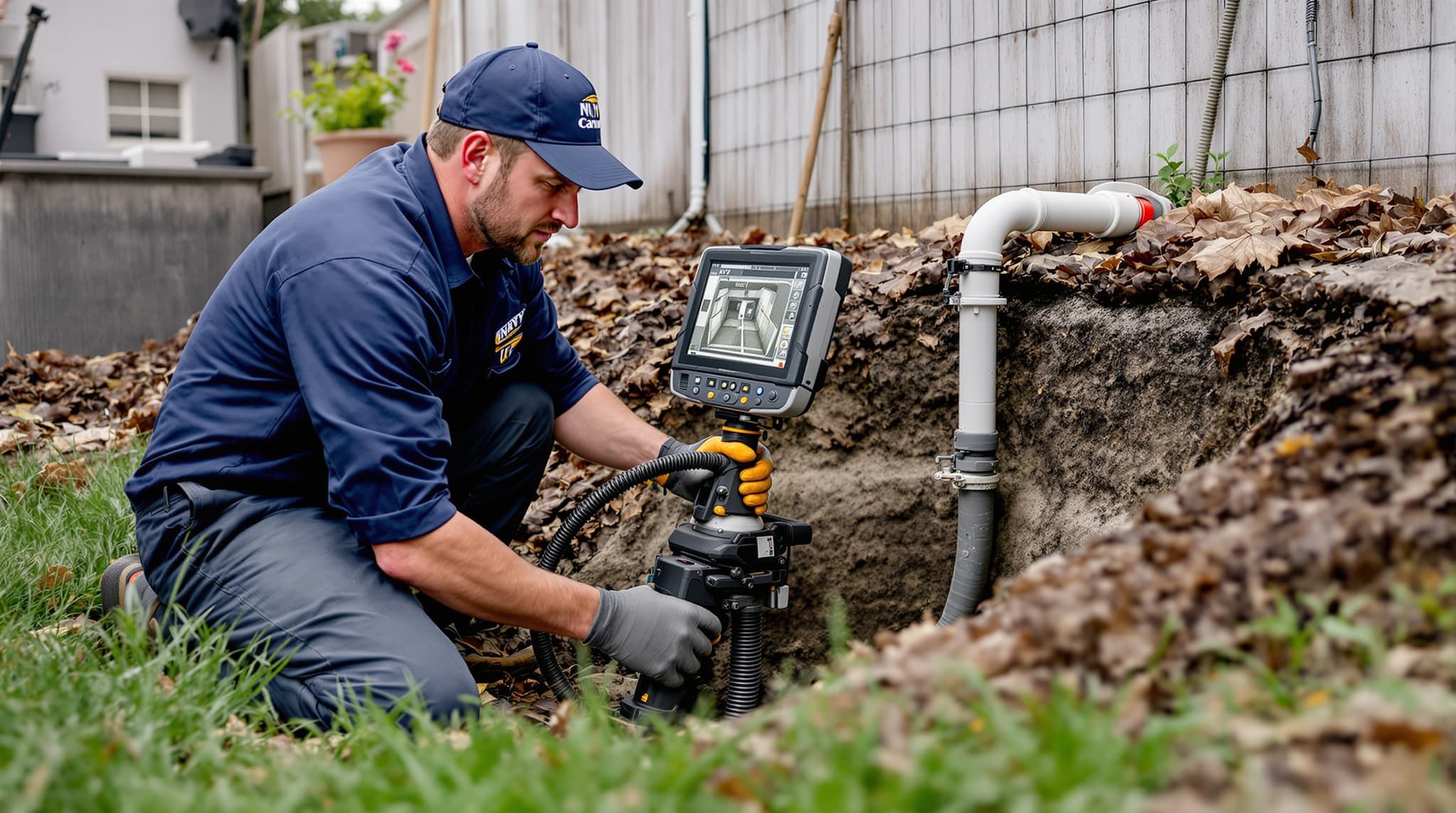
If the tank lid isn't already visible (most older Suffolk homes), we probe and expose the lid. We open the tank for visual inspection. This is what distinguishes a real inspection from a drive-by "looks fine."
Tank structural condition
- Wall condition (cracks, crumbling, rebar exposure)
- Cover condition (intact, damaged, missing)
- Riser condition (sound, cracked, collapsed)
- Signs of settling or tilting
- Watertightness (groundwater infiltration visible?)
Baffle condition
Inlet and outlet baffles inspected. Broken or missing baffles flagged.
Sludge and scum levels
Measured and documented. Tells us the actual pumping interval the house has been on, and whether the tank is overdue.
Leach field function
We run water into the tank and observe outflow. If effluent is not moving into the field or is immediately surfacing, the field is failing.
Surface evidence of failure
Wet spots, green grass patches (the lawn over a failing field grows faster), root mats visible, surface breakout, odor.
Secondary systems
If the home has an I/A system, we check the control panel, blower/air pump, treatment media condition, and any alarm history. If the home has a grinder pump or pressure-dosed field, we check those.
Compliance notes
Distance from well, setbacks from property lines, obvious SCDHS code issues.
Dye test (if requested)
For a more rigorous inspection, we run a fluorescein dye flush and see if dye surfaces anywhere inappropriate (the yard, a neighbor's yard, a nearby storm drain) within 24 hours. Additional cost, not part of the standard inspection.
What You Get After the Inspection.
A written report within 48 hours of the inspection, delivered by email PDF, covering:
- Property address and inspection date
- Tank type, estimated age, size, material
- Photos of tank interior, baffles, cover, surrounding area
- Sludge and scum measurements
- Leach field observations
- Pass / fail / conditional findings
- Recommendations (pumping, repair, replacement)
- Estimated remaining useful life
- Our conclusions in plain English
The report is suitable for your attorney, your lender, and the buyer or seller on the other side. If your lender requires a specific format or certifying language, tell us when you book and we'll match it.
Fast Turnaround for Real-Estate Deals.
Real-estate closings move fast. We prioritize inspection slots for active deals. Common timelines we hit:
- Inspection scheduled within 3 to 5 business days of your call for standard closings
- Next-day inspection for rush deals (additional rush fee)
- Written report within 48 hours of inspection (same-day turnaround available for closings in crisis)
- Follow-up repairs (if flagged) scheduled based on closing date
Tell us the closing date when you book. We'll work backwards.
What a Cesspool Inspection Costs.
For pricing ranges and what's included, see the pricing page. Inspection pricing varies based on:
- Whether the tank lid needs to be located and exposed (adds labor)
- Whether a dye test is included
- Standard report vs rush turnaround
- Travel distance (basic rate covers most of Suffolk and eastern Nassau)
We don't charge add-ons at the end. The quote you get when you book is the price on the invoice.
What We Typically Find at Real-Estate Inspections.
Based on 200-plus transaction inspections we've done over the years, here's the frequency of findings.
Clean pass (40-50% of older homes): Tank is in decent shape, baffles intact, field absorbing. Recommendation: pump within 6 to 12 months, then continue normal schedule.
Conditional pass (30-35%): Tank is functional but has minor issues (one broken baffle, cracked riser, overdue pumping). Recommendation: repair items documented, estimated cost provided.
Failed / near-failed (15-20%): Tank is at end of life, field is failing, or structural issues significant. Recommendation: replacement. This often becomes a negotiation point in the deal.
Hard fail (5-10%): System is non-functional, actively leaking, or has been abandoned. Must be replaced before closing.
We report what we find. We don't soften findings to make a deal close, and we don't inflate findings to sell a replacement job.
What a Trained Inspector Is Actually Checking
Most homeowners picture a cesspool inspection as someone glancing at the lid and filling out a form. The reality is different. Here's what a thorough inspection addresses and why each item matters in the Long Island context.
Inlet and outlet baffles. The inlet baffle slows incoming flow so solids settle rather than push directly into the leach field. The outlet baffle retains the floating scum layer. Both are commonly missing or deteriorated in pre-1980 Long Island cesspools — the original concrete and clay components break down over decades. A missing outlet baffle alone can accelerate leach field failure by years.
Leaching pool saturation. Long Island's water table averages 3 to 12 feet below grade, shallower near the South Shore, Jamaica Bay, and tidal areas. A leaching pool in saturated soil isn't absorbing — effluent backs up into the primary tank. We observe outflow under active water load, not just at rest.
Tank structural integrity. Pre-cast concrete tanks installed before 1975 often show cracking, spalling, or wall separation — especially after the freeze-thaw cycling of a hard winter. Rebar exposure in wet cesspools is a hard-fail finding. We check wall condition, cover integrity, and signs of ground settlement.
Nassau County 2019 pre-sale upgrade requirement. Nassau County enacted rules requiring cesspool systems in nitrogen-sensitive areas to be upgraded to I/A (innovative/alternative) systems as a condition of property transfer. If your property is in a designated N-sensitive zone — common in areas near bays, harbors, and estuaries — a standard cesspool cannot simply be "passed" at inspection; you may be required to upgrade before the deed transfers. We flag this during every Nassau inspection and provide the specific SCDHS or Nassau DOH guidance for your address.
Cesspool Inspections Across Long Island.
We perform cesspool and septic inspections throughout Suffolk County and into eastern Nassau. Common towns we inspect in each week:
Suffolk County (our core territory): Smithtown, Hauppauge, Commack, Huntington, Bay Shore, Islip, Patchogue, Sayville, Babylon, West Babylon, Port Jefferson, Stony Brook, Riverhead, Brookhaven, Ronkonkoma, East Northport.
Nassau County (eastern Nassau): Massapequa, Massapequa Park, Bethpage, Hicksville, Levittown, Wantagh, Seaford, Merrick, and surrounding communities.
Every Long Island cesspool inspection follows the same protocol — locate and expose the tank, camera or visual interior inspection, leach field observation, written report within 48 hours, SCDHS-compliant documentation. Suffolk and Nassau DOH formats both covered.
If you're not sure whether we service your ZIP code, call dispatch. We cover virtually all of Long Island for pre-purchase inspection work, and we schedule around closing timelines.